
Sonotube Calculator
Round cardboard forms make deck, porch and post footings easy — the question is how much concrete to buy. Enter the tube diameter, height and how many you need, and this calculator gives cubic feet, cubic yards and the number of premix bags, with an allowance for spills and an optional spread footing at the base.
- Free to use
- No sign-up
- Runs in your browser
Sonotube calculator
Footing Concrete Template Pack
Footing concrete calculator spreadsheet, printable concrete-per-foot and bag chart, deck footing layout grid, pour-day checklist and a materials list.
- Footing calculator (XLSX)
- Per-foot chart (PDF)
- Layout grid (PDF)
- Pour-day checklist (PDF/DOCX)
- Materials list (PDF/DOCX/XLSX)
Formats: XLSX, PDF, DOCX. Instant download after payment (link valid 72 hours, up to 5 downloads). AI-assisted: the templates were drafted with AI help and reviewed and laid out before publishing.
$5.00 USD, one-time 5 files · about $1.00 each
- Instant download
- 7-day refund
- Secure checkout by Stripe
7-day money-back guarantee. Full refund within 7 days of purchase, even after you download.
Free sample: Footing Calculator (PDF, 57 KB)
Full refund within 7 days — see the refund policy and license.
Free printables
Single sheets you can print right now, no sign-up. The full pack adds every sheet in one download plus the editable files.
 Printable Footing Concrete Calculator
 Printable Sonotube Concrete Per-Foot Chart
 Printable Footing Layout Grid
 Printable Pour-Day Checklist
 Printable Footing Materials List
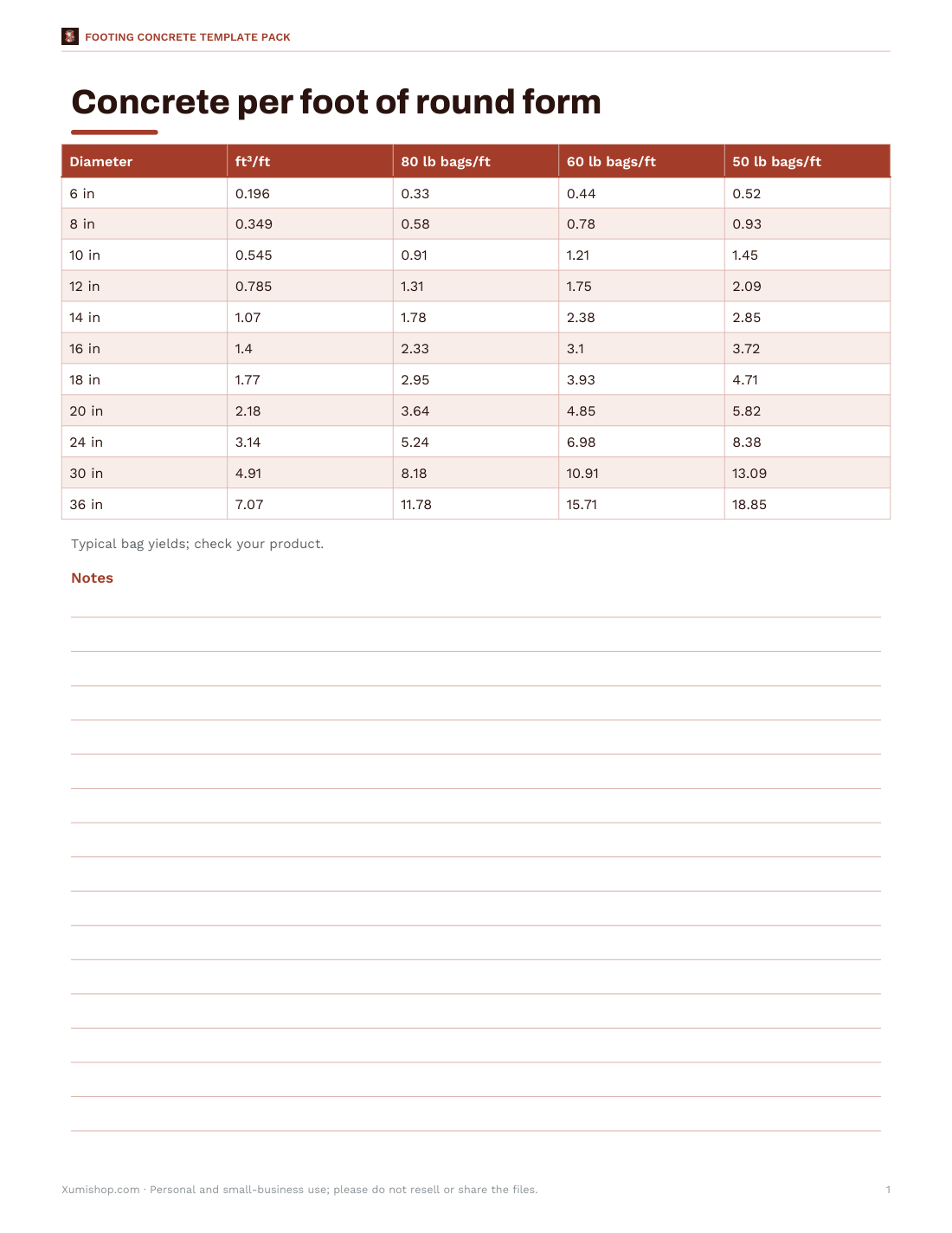
Concrete per foot of tube
| Diameter | ft³ per foot | yd³ per foot | 80 lb bags per foot | 60 lb bags per foot |
|---|---|---|---|---|
| 6 in | 0.196 | 0.0073 | 0.33 | 0.44 |
| 8 in | 0.349 | 0.0129 | 0.58 | 0.78 |
| 10 in | 0.545 | 0.0202 | 0.91 | 1.21 |
| 12 in | 0.785 | 0.0291 | 1.31 | 1.75 |
| 14 in | 1.069 | 0.0396 | 1.78 | 2.38 |
| 16 in | 1.396 | 0.0517 | 2.33 | 3.10 |
| 18 in | 1.767 | 0.0654 | 2.95 | 3.93 |
| 20 in | 2.182 | 0.0808 | 3.64 | 4.85 |
| 24 in | 3.142 | 0.1164 | 5.24 | 6.98 |
| 30 in | 4.909 | 0.1818 | 8.18 | 10.91 |
| 36 in | 7.069 | 0.2618 | 11.78 | 15.71 |
Volume of a cylinder = π × radius² × height. With the diameter in inches and height in feet: ft³ = 3.1416 × (diameter ÷ 24)² × height.
Worked example: deck footings
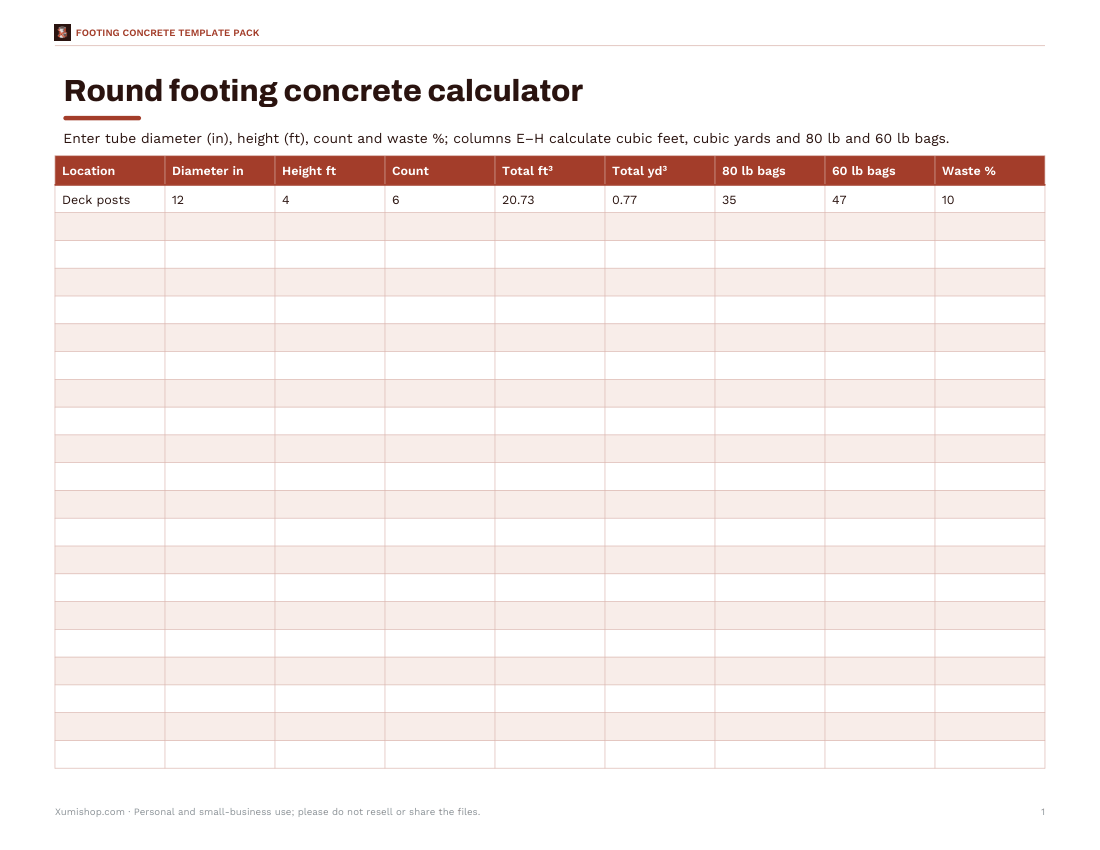
A deck needs six 12-inch footings, each 4 feet deep. One tube holds π × 0.5² × 4 = 3.14 ft³, so six hold 18.85 ft³. Adding 10% for spills and overfill gives 20.73 ft³ (0.77 yd³) — about 35 bags of 80 lb premix at roughly 0.6 ft³ per bag. That’s a lot of bags to mix by hand, so the builder rents a mixer and gets help for the pour.
Bag yields
| Bag size | Typical yield | Bags per cubic yard |
|---|---|---|
| 40 lb | ≈ 0.3 ft³ | 90 |
| 50 lb | ≈ 0.375 ft³ | 72 |
| 60 lb | ≈ 0.45 ft³ | 60 |
| 80 lb | ≈ 0.6 ft³ | 45 |
Yields vary slightly by product — the bag states its coverage. Fast-setting mixes used dry in post holes follow their own instructions.
Footing depth and size
- Footings must usually extend below the local frost line — ask your building department for the required depth.
- Diameter and base size depend on the load and soil; deck plans and span tables specify them.
- Many codes require footings to bear on undisturbed soil, often with a wider base than the column.
- Bell-shaped or square footing pads spread the load; the calculator can add a square pad under each tube.
- Permits and inspections are commonly required for decks and structures.
Pouring tips
- Dig holes a few inches wider than the tube and set the tube level and plumb.
- Backfill around the tube to hold it in place (or brace it).
- Mix concrete to a workable consistency — not soupy.
- Fill in lifts, rodding or tapping the tube to remove air pockets.
- Set anchor bolts or post bases while the concrete is wet, checking layout with a string line.
- Let it cure before loading; peel off the exposed cardboard afterwards.
Bags vs ready-mix
| Amount of concrete | Usual choice | Why |
|---|---|---|
| Under about ½ yd³ | Bagged premix | Easy to handle; mix in a wheelbarrow or small mixer |
| About ½–1 yd³ | Bags with a rented mixer, or a trailer load | Many bags — plan help and time |
| Over 1 yd³ | Ready-mix truck or short-load delivery | Consistent mix, much less labour; minimums and short-load fees apply |
For many small footings spread around a site, a concrete pump or buggy may be needed if a truck can’t reach each hole.
Choosing a tube size
Tube diameter is usually set by the post size and the load it carries. A 4×4 post often sits on an 8- or 10-inch column, and a 6×6 on a 10- or 12-inch column, but the footing pad under the column — not the tube — spreads the load into the soil, so its size matters more. Deck plans, local span tables and building inspectors specify both; use the calculator once you know the sizes to work out the concrete.
Common mistakes
- Using the tube diameter as the radius — divide by 2.
- Forgetting concrete in the flared base or footing pad.
- Not allowing for holes dug wider than the tube where concrete fills the gap.
- Underestimating how many bags are needed and running out mid-pour.
- Pouring in freezing weather without protection.
What’s in the template pack
- Footing concrete calculator spreadsheet for multiple tube sizes
- Printable concrete-per-foot and bag chart
- Deck footing layout sheet on a grid
- Pour-day checklist
- Materials list with quantities
The pack is a one-time download; the calculator is free.
Frequently asked questions
How much concrete is in a 12 inch Sonotube?
About 0.79 ft³ per foot of height — about 1.3 bags of 80 lb mix.
How many 80 lb bags fill a 10 inch tube?
About 0.9 bag per foot of height.
How many bags are in a cubic yard?
About 45 bags of 80 lb premix at 0.6 ft³ each.
How deep should deck footings be?
Below your local frost line — check with your building department.
Should I add extra?
Yes — 5–10% extra covers spills and uneven holes.
Is Sonotube a brand?
Sonoco’s Sonotube is a well-known brand; this calculator works for any round form.
How long before I can build on the footings?
Concrete gains strength over days; follow the mix instructions and your builder’s guidance — often several days before heavy loads.
Do I need rebar in a Sonotube?
Many designs call for vertical rebar in footings; follow your plans or local code.
Can I cut a Sonotube to length?
Yes — cut it with a handsaw or reciprocating saw, keeping the end square.
What height should the tube stick out of the ground?
Often a few inches above grade so wood posts stay dry; follow your plans.